Blogroll
Contact
This form does not yet contain any fields.
    Holger Danske

    Holger Danske

    Entries in Patents (3)

    Thursday
    Sep022010

    Patent Trolls 2

    A friend sends this along:

    A lower court had ruled Stauffer lacked standing because he did not allege an actual injury to a Brooks Brothers competitor, the bow-tie market, the economy or the public, Law360 says.

    Reuters says false marking suits like Stauffer’s “have become something of a cottage industry in the patent world.” Another lawyer who sought trillions of dollars in damages in a suit over an expired Solo Cup patentlost his case in June when the Federal Circuit ruled he had failed to prove the company intended to deceive the public with the false mark.
    That issue remains in Stauffer’s case. The appeals court instructed the lower court to address the merits of the case, including Brooks Brothers’ motion to dismiss claiming Stauffer failed to adequately allege an intent to deceive.

    The critical element is intent, without it the ridiculous damages will never be awarded.

    Wednesday
    Sep012010

    Patent Trolls

    Tuesday
    Oct202009

    Is the rate of intellectual discovery slowing?

    Earlier this month on Jerry Pournelle's website, I saw some discussion about whether the rate of technological progress is slowing. This is something that I had heard before, so I thought it might be interesting to look into the subject a little further.

    The discussion on Chaos Manor cited an article on Taki's Mag, and another from IEEE Spectrum. The article on Taki's further cites Charles Murray's Human Accomplishment. Murray did make a similar claim in Human Accomplishment, but I think it might be interesting to revisit some data from Cycles: The Science of Prediction. If you have ever heard the urban legend that a Patent Commissioner once wanted to close the US Patent Office because there was nothing left to invent, this is the data the mythical commissioner was probably looking at. The data in the image below comes from the work of Pitrim Sorokin, in his book The Crisis of our Age. The data on inventions and discoveries is not graphed, so I did that below, both on linear and semilog scales.

    Pp. 218-9 of Cycles: The Science of Prediction

    There is a very clear flattening of the curve when plotted this way. It looks pretty similar no matter which way you plot it. It is somewhat unclear from Sorokin's book what counts as a scientific discovery or invention, so I'll look at US Patent rates instead.

    Sorokin Data on Linear and Semilog Axes

    The graph on page 219 of Cycles ought to be pretty easy to reproduce. The US Patent and Trademark Office has the total number of patents issued up to the present:

    http://www.uspto.gov/web/offices/ac/ido/oeip/taf/h_counts.htm

    http://www.uspto.gov/web/offices/ac/ido/oeip/taf/h_counts.pdf

    And the US Census has population estimates for each year:

    http://www.census.gov/popest/national/national.html

    But only back to 1900, so I'll truncate the patent data there. This is what we get.

     US Patents Per Capita

    US Patents Per Capita Semilog

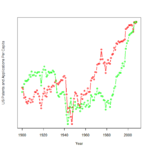
    The answer is no, the rate of US Patents at least is not slowing per capita. There is a big dip in WWII, and a big spike in 1976, but otherwise looking at the log plot we see a very steady slope from WWII to the present. That big spike in 1976 is strange. Looking at the patent applications on the same graph, there was an upsurge in applications before 1976, but the rate of applications was flat until 1984, when it took off. Apparently, more and more of the applications were resulting in patents until that point.

    US Patent Applications and Issued Patents Semilog

    The graph does basically reproduce the features on Dewey and Dakin's graph in the period 1900-1944, but it seems smoother, which is probably because they smoothed all their data, since it was part of their theory of cycles that you applied Fourier analysis to time series data to find persistent cycles. They smoothed their data to make this easier.