Blogroll
Contact
This form does not yet contain any fields.
    Holger Danske

    Holger Danske

    Entries in Italy (5)

    Sunday
    Aug012010

    Italy Annoys Economists

    Steve Sailer has a good bit on Italy today via the New York Times.

    Italy mystifies economists by refusing to embrace the conventional wisdom

    Economists said that Mr. Barbera had a point, but they also said that worrying about this issue was like fretting about the head cold of a patient with Stage 3 cancer. They see a country with a service sector dominated by guilds, which don’t just overcharge but also raise the barriers to entry for the millions in ill-fated manufacturing jobs who might otherwise find work as, for instance, taxi drivers. They see a timid entrepreneur class. They see a political system in the thrall of the older voters who want to keep what they have, even if it dooms the nation to years of stasis.

    They see a society whose best and brightest are leaving and not being replaced by immigrants, because Italy has so little upward mobility to offer.

    I have often thought of driving a taxi as a step up from working on an assembly line. I am also a little curious who we are going to bring in to replace those top Italian fashion designers, engineers, and craftsmen who leave Italy for better opportunities. More taxi drivers, perhaps?

    I liked the NY Times article because I learned about how the Italians do business. There is definitely some justice in the complaint that outsiders tend to group Italy in with the other countries that surround the Mediterranean [the PIIGS], when Italy is really not near so irresponsible as Greece or as economically backwards as Spain.

    However, doing business in Italy would be maddening. Workers are nearly impossible to fire, associations keep the prices high for everything from taxis to legal advice, and the Italian bureaucracy is renowned for its ability to prevent productive activity. Yet, nonetheless, life in Italy is not that bad.

    Theodore Dalrymple documentes the visible changes in Italy from the time he first visited:

    I first went to Italy as a boy in 1960, the year of the Rome Olympics, and it was still recognizably a poor country. The standard of living was not very different from that of Cuba before the overthrow of Batista. In one town in Sicily, the country’s poorest region, 3,404 humans shared 700 rooms with 5,085 animals, among them pigs, goats, and donkeys. Animal dung, still used as fertilizer, was piled up in the Sicilian streets awaiting use. Visitors from Britain to the Italian peninsula had to treat the water supply with suspicion. My first Italian sojourn ended abruptly when, aged ten, I became delirious from fever and had to be moved to Switzerland to recover; despite the many and dire warnings, I had drunk the Italian tap water. I had not liked to ask my parents all the time for acqua minerale.

    The infant mortality rate in the year in which I was born was at least three times higher in Italy than in Britain. Now, half a century later, it is lower than in Britain, and Italians in general live longer and healthier lives than Britons. Not only is Italy noticeably richer than Britain, but it is also considerably cleaner. Recently, the newspaper La Repubblica carried an article wondering why the British food supply was so unclean and unsafe

    Dalrymple notes that one of the saving graces of Italy is its enduring corruption. Italy has one of the biggest black markets in Europe, and tax evasion is a way of life for all classes.

    The need to evade the depredations of the state and to make alternative arrangements for functions (like social security) that the state claimed, but usually failed, to carry out, meant that the Italian population had to fend for itself. With governments that fell like skittles—and quite long periods without any government at all—no Italian could possibly imagine that the politicians or the state they governed held the key to their prosperity. Necessity in Italy was not so much the mother of invention as of economic flexibility, opportunism (in the best sense), and family solidarity.

    Italy's unusual business practices are rooted in their history. Distrust of the national government is not particularly surprising given Italy's recent unification by force. Rapid economic change produces rapid economic dislocations. Honest government and widespread social trust are necessary to counteract the creative destruction of unbridled capitalism. When neither government nor society at large can provide this, people must turn to their own resources, which in practice means relying on your family.

    Sunday
    Apr252010

    Gunslinger Girl Il Teatrino OVA Anime Review

    Gunslinger Girl

    Gunslinger Girl: Il Teatrino OVA

    Written by Yu Aida 相田 裕 Aida Yutaka
    Published by Funimation


    Gunslinger Girl Il Teatrino OVAガンスリンガー·ガール Gansuringā Gāru

    Gunslinger Girl: Il Teatrino OVA is a continuation of season 2 of the Gunslinger Girl anime. This OVA seems to be something of an apology for the the lackluster animation of the second season of the anime. It is not the best I have ever seen, but it is definitely better than Il Teatrino. This OVA is still personally supervised by Yu Aida, so it hews closely to the manga.

    If you have come here without reading my review of the first two seasons of Gunslinger Girl, go do so now. You are not going to find anything new in this OVA that wasn't discussed in that review. I have not yet reviewed the manga separately, but one thing that is notably different is the editor's notes that appear in some volumes of the US release. These notes explain a great deal of the intrigues of Italy and fun facts about the locales of the series. The anime lacks these, but the OVA did have a scene early on that explained just what Padiana is and the wealth disparity between the north and south of Italy that is fueling the terrorism with which the Social Welfare Agency deals.

    I checked Volume 6 of the manga, and I did not see this bit of exposition, but it is good background information. The OVA itself is very short. I watched this on Netflix, so the fact that only two episodes were on the disc was tolerable, but I would have been pissed if I had paid money for it. Two episodes is not worth $15-$20. I know damn good and well that OVAs such as this retail for $60 in Japan, but that is ridiculous.

    There was a nice bit of character development in this OVA, but it comprised about a third of Volume 6 of the manga, so you could get the same story a lot cheaper that way. Fanboys will probably buy it just the same, but I'm more than happy to rent.


    My other anime reviews

    Tuesday
    Feb022010

    Gunslinger Girl Anime Review

    Gunslinger Girl

    Gunslinger Girl: Il Teatrino

    Written by Yu Aida 相田 裕 Aida Yutaka
    Published by Funimation 


    Gunslinger Girl

    ガンスリンガー·ガール Gansuringā Gāru

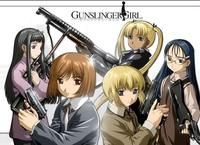
    This review covers the two anime series Gunslinger Girl and Gunslinger Girl: Il Teatrino. Each is a 13-episode adaption of the manga by Yu Aida. Each season covers only part of the manga, which as of the time of this review has 11 volumes published in Japan. These seasons cover roughly the first six volumes, but not exhaustively.

    The first season is simply beautifully done. Motions are fluid, proportions are maintained in perspective, and detail is high. However, the first season is rather unfocused, not following any particular story arc with any fidelity. Il Teatrino on the other hand, was personally supervised by Aida, and consequently is very tightly plotted, but suffers from lackluster animation that is often crudely drawn. I enjoyed both seasons, but these differing strengths ought to be borne in mind by any potential viewers.

    Gunslinger Girl is a story both about the fractious nature of Italian politics and the consequences borne by the players in the Great Game of politics by other means. The focus is upon the fratello of the Social Welfare Agency. The Social Welfare Agency is a front for a mysterious organization known only as Section 2. They do in fact do some good, because the same technology that allows them to create cyborg assassins can also be used to cure the lame and allow the blind to see. However, that is not the Agency's primary purpose. Their job is to eliminate the enemies of the Italian state.

    Each fratello is a team composed of a handler and a cyborg. The handlers are usually recruited from the military or from other intelligence agencies, whereas the cyborgs are created from orphans rescued from hospitals. I say rescued, when perhaps kidnapped would be more accurate. Only orphans are used, and most often the girls selected would otherwise die if not for the intervention of the Agency. Only girls are used, because for some reason the process works better on girls, the younger the better.

    This sounds horrible, and it is, but there is at least a patina of actual concern layered over the Machiavellian purpose of Section 2. In addition to being crippled, the girls have usually been psychologically traumatized. The psychoactive drugs used to control the girls and unite them with their mechanical bodies have the blessed side effect of erasing their memories: they cannot remember their families or their families terrible ends. The girls cannot remember their past lives, but every night they silently weep in their sleep, mourning their lost humanity.

    Accordingly, their handlers must fill the roles of father, brother, and even lover. This is not to say that we have mechanical lolitas. The drugs were meant to produce unquestioning obedience, but instead prompt a fierce, and even dangerously unstable attachment born of the girls' need to be loved. This provides the central drama of the series, because even the hardened men who are recruited for Section 2 cannot easily reconcile themselves to what they are really doing.

    This is compounded by the the tradeoff produced by the conditioning: more conditioning produces a more pliable girl, but makes her duller and shortens her life. Those handlers who choose to minimize the conditioning find they need to buy their cyborgs teddy bears and take them on outings to maximize their kill count. For dramatic purposes, most of the handlers have psychological hangups involving innocent young girls. You would think a mysterious government agency could vet their employees better, but that is not really the point here.

    The central drama is provided by the essential immorality of using brainwashed girls as assassins, but the series would not be near so interesting if it weren't set in an Italy of the near future. I am not an expert on Italian history or politics, but what I do know very much tracks with what you see in Gunslinger Girl. Italian politics in some ways still operates in the Renaissance mode of constant intrigue and upheaval. Add on top of this the recent unification of Italy into a nation by force, the influence of the Mafia in the south, and the critical role Italy played in the Cold War and you have many well-armed and well-financed factions prepared to fight for power. The separatist Padania organization featured in the series actually has real world counterparts in Italy. It is of course unwise to get historical and political information exclusively from entertainment, but as long as one keeps the inherent limitations of the medium in mind this is a good way to spur interest in a subject.

    I would classify Gunslinger Girl as gun porn, in the same sense Steve Sailer refers to movies like Brideshead Revisited and Atonement as period porn. Each gun is lovingly drawn, a precise representation of an actual firearm. Since gun ownership is nearly nonexistent in Japan, there is a gun-loving subculture there that finds fulfillment in anime like this and in buying very expensive Airsoft replicas of real guns. Each gun used by one of the girls is readily identifiable: Henrietta's FN Herstal P90, Triela's Winchester 1897 Trench Gun, or Rico's CZ-75 pistol. This, and the lolita aspect probably explain the series' popularity, but there is an underlying historical acumen that makes this anime worth seeing.

    My other anime reviews


    Sunday
    Jun142009

    Italian Politics

    Anyone wishing a brief primer on Italian politics after WWII might consult Steve Sailer's review of the movie Il Divo. Italian politics in some ways still operates in the Renaissance mode of constant intrigue and upheaval. Overlaid on that was the colonization of the South by the North when Italy was unified as a nation, and then further overlaid with the Cold War struggle between the United States and the Soviet Union. Recent Italian politics have included such mysteries as the death of Roberto Calvi, and Gladio, the secret guerilla force created in case the Russians successfully captured Italy.

    Wednesday
    Jun102009

    How Many Divisions does the Pope have?

    A fun piece of history, and an interesting artifact, is the M1868 Pontifico, the only modern rifle ever manufactured specifically for the Vatican. An extremely rare military rifle, the M1868 was manufactured for the Zuavi Pontifici, the international brigade that defended the Papal States. There were a mere 5,000 Zuavi, the Papal States being by the 1860s a small and derelict Italian principality left behind by the great nationalist movements of the XIXth century. When King Victor Emmanuel II annexed the Papal States in 1868, the Zuavi had no hope of preserving the independence of the Papal States by force of arms. Pope Pius IX retreated inside the walls of the Vatican, and never again left until his death in 1878.

    This represented a nadir of the power of the papacy both politically and spiritually. The nationalist movements meant that the local churches were largely under the control of the nation state. The remaining properties of the monastic orders were seized even in Catholic countries. Following his election as abbot in 1868, Gregor Mendel spent the latter part of his life defending his abbey from the depredations of the Hapsburgs, to the detriment of further experiments in genetics.

    Pio Nono (as Pius IX was familiarly known), was famously not amused by this development. The Syllabus of Errors actually dates from before the loss of the Papal States, but the more time Pius IX had to think about the new world order, the less he found to like about it. This dislike is not entirely without justification. The unification of Italy had something of a colonial character, with the North dominating the South. The strife between the industrial North and the agrarian South of Italy continue to this day. [the North makes Ferraris, the south Mafiosi]

    The involuntary stripping of the Papal States from the Pope had the paradoxical effect of making the Papacy stronger. Freed from the distractions of temporal rule, the popes eventually discovered a profound moral authority as the only remaining transnational institution in the West.  This was abetted by the very success of the nation state, which had discovered an astounding ability to tax and organize the lives and possessions of its subjects. This enabled great progress as well as great devastation: the Great War would not have been possible without the nationalist ability to mobilize the entire citizenry of a state to fight a war. The Papacy functioned here as a court of last resort, the only existing institution you could appeal to over the nation state.

    This did not occur immediately, but developed over the course of two generations, taking full flower in the social teachings of Pope Leo XIII. The international reach and prestige of the papacy has continued to increase ever since.

    Thus when Stalin asked, "how many divisions does the Pope have?", he did not realize that the elimination of the last remnant of the Papal armies had made the Pope more powerful than ever.

    h/t DarwinCatholic